What makes Studio Ghibli films so special? We often see two sides of Japan in the media, one more accentuated than the other. The wacky and the bizarre world of futuristic design and technology, the robots, bullet train, anime and vending machines on the one hand; the modesty and minimalism, meticulous attention to detail and quality, the quiet appreciation for nature on the other. To me, it seemed like the culture was teeming with a unique kind of spirituality, but I didn’t really understand what that was. The films of Studio Ghibli capture this charm perfectly, and many of us find something very special in them that is not present in, say, the Disney canon.
Looking into religion in Japan, some of this is elucidated. Religion is experienced very differently to how Abrahamic religions are experienced and practiced in the West. It is said that Japanese are born Shinto, marry Christian and die Buddhist. This is because Japanese babies are registered in a Shinto shrine soon after their birth, a lot of Japanese choose to marry in churches, while many prefer Buddhist funerals for their simplicity. So religion is not seen as exclusive, it is quite à la carte as one goes through the different life stages.
Shintoism is the ancestral religion of Japan, while some view it more like a ‘way’ or a tradition. It is a polytheistic and animistic religion, broadly defined as ‘a belief in the the kami‘ by scholars, which are gods or spirits inhabiting all things. So, much like Thales said, ‘all things are full of gods’ in Shinto belief. Kami are often local guardian spirits limited to a mountain, a forest or even a room of a house; they are not considered all powerful or all knowing. Some of them, like Inari, the god of rice, have larger cults and shrines all over the country. The kami seem to be supernatural entities with a different nature, or special powers that inspire awe and wonder. They consist a huge part of Japanese mythology and folklore, worshipped in public shrines, jinja, or private home shrines, kamidana. Humans can also become kami after they die (as they become ancestors), or even before: the emperor was venerated as a kami during the Meiji period.
The animism of Shinto is what gives sense that everything is teeming with spirituality. In fact, the kami were thought to as formless and invisible until the later Buddhist influence led them to be depicted anthropomorphically. Natural phenomena themselves are divine, the kami are intrinsically incorporated into the everyday rather than transcendent to it. Shinto aims to cultivate a harmonious relationship between nature mediated by the kami and humans. I think this perspective on nature perseveres in Japanese mentality, putting aside the relevance of any formalised belief system.
All of this will be familiar to Ghibli fans. Two films that this is very strongly felt are My Neigbour Totoro (1988) and Princess Mononoke (1997), directed by the recently retired legend Hayao Miyazaki. We see very different aspects of Japanese spirituality in these films.
Leaving aside the plentiful mythological references in these films, the way nature is presented in Ghibli is deeply moving. It is simply remarkably beautiful, truly inspiring awe and wonder. Yet, in Princess Mononoke and many other films in the Ghibli canon, this beauty is threatened by humans’ greed, the bouts of war and industrialisation. This evokes the wrath of the kami, who turn vengeful against the humans. In Japanese folklore, the kami are often benevolent when satisfied, but destructive if provoked or neglected; bringing illness, natural disasters, death and destruction to humans. We see this side of them in Princess Mononoke, where our hero Ashitaka travels west to reconcile the warring humans and spirits upon being cursed by a kami-turned-demon escaping the conflict.
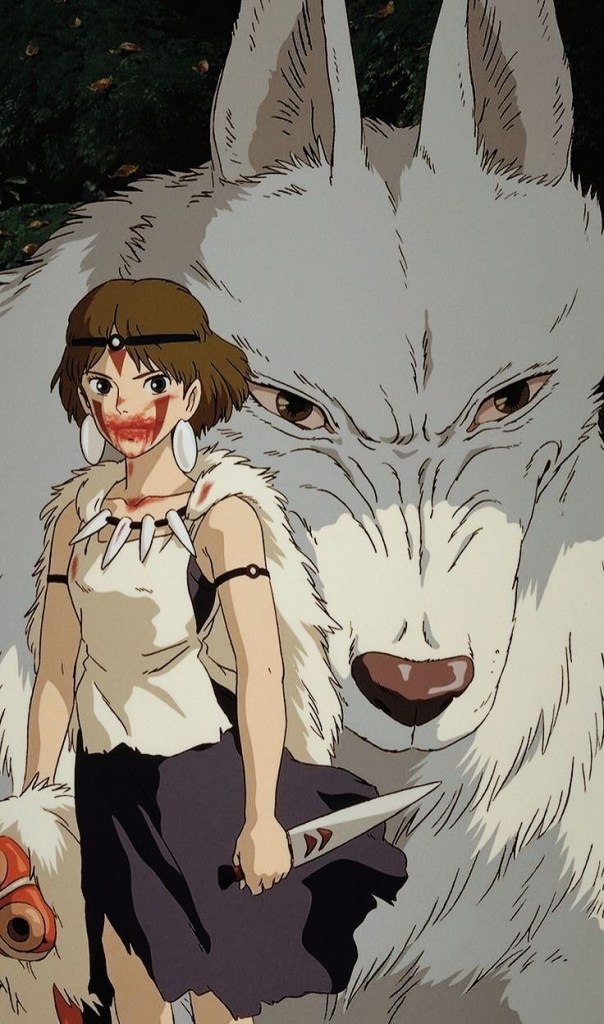
Princess Mononoke, raised by the wolf deities, she grows up to be a part of the pack and a fierce defender of the Forest against human intruders
Studio Ghibli
Miyazaki is not undiscerning in his critique of human action threatening nature. He acknowledges the human motivation for survival driving these destructive forces. For example, the morally ambiguous Lady Eboshi in Princess Mononoke is not presented as a plain villain, though as the master of Iron Town she is directly responsible for the pollution and deforestation that is endangering the forest. She is a complicated character, a strong woman standing against the spirit realm on the one hand, and traditional concentrations of power wanting a piece of her iron wealth on the other. She saves many women from prostitution by providing them work, similarly tends to the socially outcast lepers. One could cynically suggest that she is exploiting the most vulnerable members of society to minimise labour costs, indeed she doesn’t stop to check for casualties after a skirmish early in the film which supports this view. However, I think her motivations are very familiar to us: a concoction of a capitalistic self interest that aligns with some economic benefit to society through employment and development. In other words, the same neoliberal ideology of the transnational capitalist class that mandates our current systems.
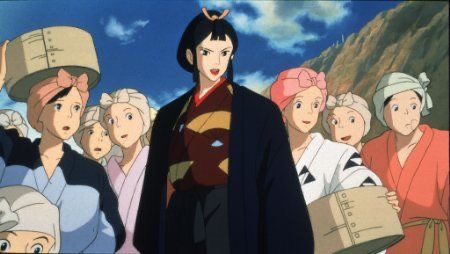
Lady Eboshi with her emancipated workers
Studio Ghibli
Though Miyazaki himself is famously pessimistic about the future of our natural world, he spares his young audience from much of this anxiety. In Princess Mononoke, the Forest Spirit is killed, but all is not lost: he is not gone because the Spirit is life itself, as our hero Ashitaka says in a very Shinto fashion. The film resolves in a compromise, a new era of harmony spearheaded by the Princess who goes back to the forest and Ashitaka who remains to rebuild the Iron Town.
In contrast to the sense of the impending environmental doom depicted in Princess Mononoke, My Neighbour Totoro is all comfort and feels. This makes sense considering Totoro was initially released in Japan as part of a double bill with the heart-wrenching WW2 drama Grave of the Fireflies, a film I haven’t dared to see a second time. In Totoro, we follow two girls as they move into a house haunted by spirits, and become friends with the forest kami, Totoro, who are lovely forest spirits. They are fluffy mixtures of raccoons, cats and owls; indeed I think they are the most huggable creations in all of Ghibli. Their king resides hidden in a spectacularly tall Camphor tree, only revealing himself to humans if he wishes . They help the protagonists Satsuki and Mei through the difficulties of their mother’s illness and absence, as well as moving into the countryside. Their parents are very supportive of the girls’ exploration of the spiritual realm, they share in the wonder and excitement of encountering these special beings. What is interesting is that the girls’ father is an anthropology professor, a social scientist positively studying precisely such cultural beliefs and practices . Yet, despite being a man of science, he is genuinely not skeptical about the girls’ supernatural claims. His participation in the girls adventures is more than childish role play, as his lack of surprise in the final scene upon finding the magically appearing corn cob on the windowsill verifies. This is not a random decision by Miyazaki: the Shinto beliefs entrenched in Japanese tradition and mindset are not taken to be rivalling any modern pursuit.
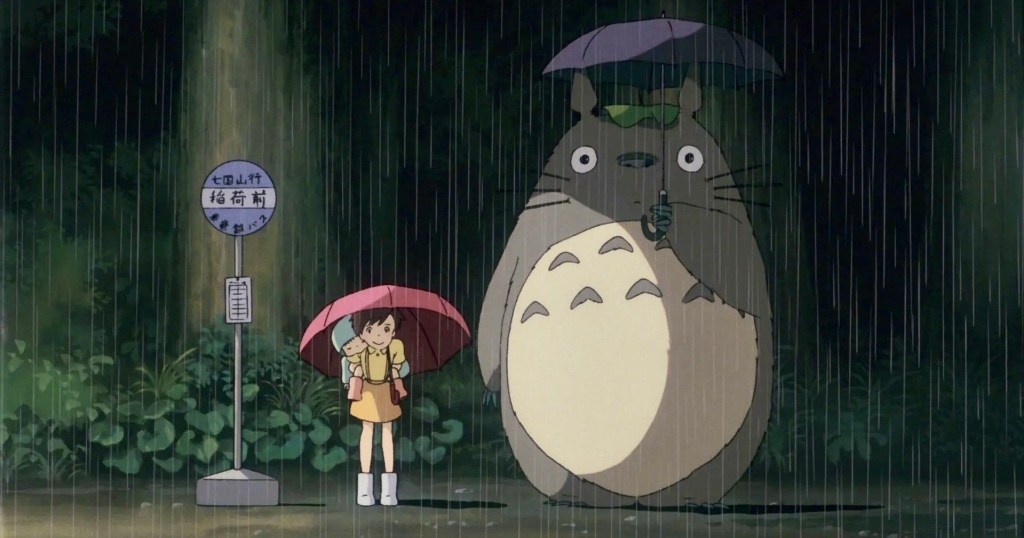
One of the most iconic scenes from Studio Ghibli
Overall, while Princess Mononoke provides an animistic critique of the environmental crisis through the provoked rage and hatred of the kami, their imminence in My Neighbour Totoro provides a sense of strong kinship with nature that is comforting, alleviating the protagonists’ fear and loneliness. The audience participates in this regardless of how much they know about the underlying Japanese folklore, explaining the worldwide popularity Studio Ghibli despite their cultural specificity.

